Shared Wall And Parapet
Cracked parapet caps and gaps in counterflashing along a shared wall let water into both buildings. Stains on the inside face of the shared wall are the giveaway.

Pima, AZ
As a commercial roofing contractor serving Pima, we repair and replace roofs on main-street and farm-trade buildings, including roofs that share a wall with the neighbor.
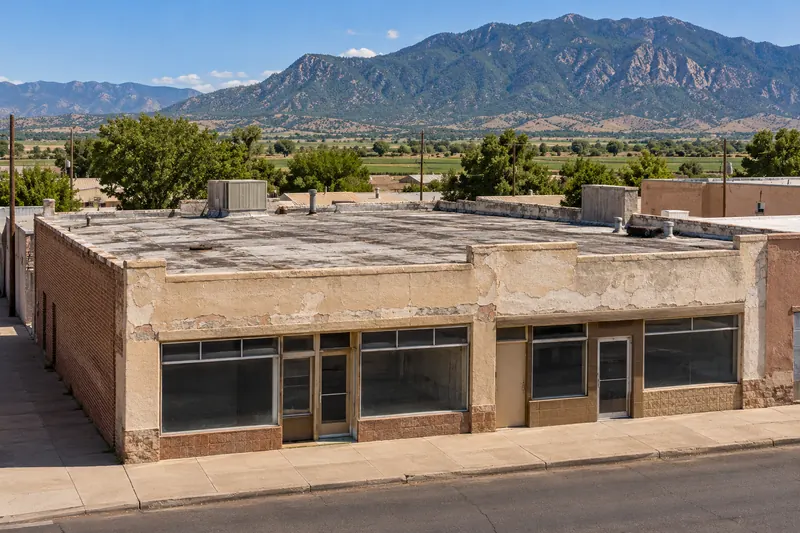
Pima Angle
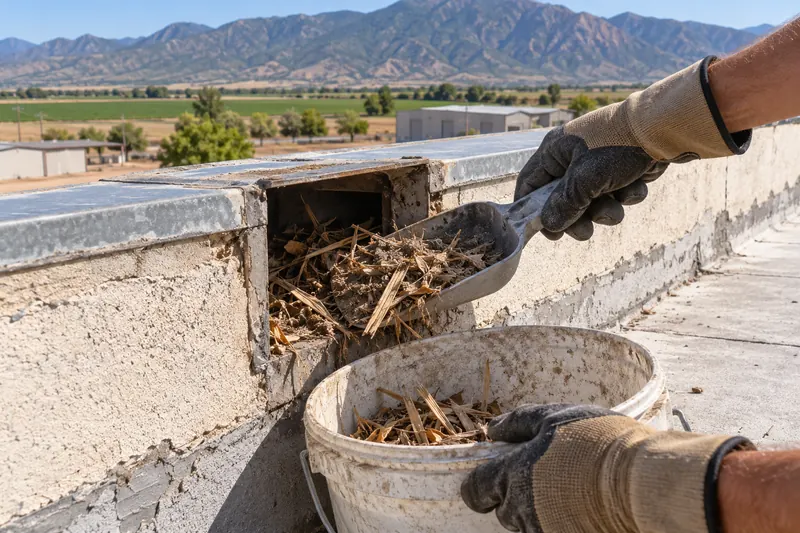
Pima was founded in 1879 as an irrigated farming center on the Gila River, and its older commercial buildings serve that farm trade. Where two buildings share a wall, their roofs meet at a parapet, a step, or a shared gutter, and a leak at that line can come from either side.
Good scopes on these roofs name the tie-in detail, who drains onto whom, and how the work gets sequenced with the owner next door.
Pima Roof Zones
Older adjoining buildings add one more trouble spot to the usual list: the line where your roof meets the neighbor's.
Cracked parapet caps and gaps in counterflashing along a shared wall let water into both buildings. Stains on the inside face of the shared wall are the giveaway.
Patched roofs with layers of mastic over old seams crack in summer heat and leak at the patch edges. Several patch layers usually mean the field needs replacing.
Shared gutters and scuppers between buildings fill with dust and debris. When one scupper clogs, water can spill onto the neighbor's roof and find their seams.
Evaporative coolers and newer units often sit on curbs that were flashed more than once. Layers of tar and sealant around the curb hide rusted metal underneath.
Wood decks on older storefronts soften where leaks ran for years. Soft spots near the parapet or a step in the roof get checked before anyone walks heavy material across them.
Pima Seasons
Pima sits at about 2,846 feet on the Gila River, northwest of Safford on US-70, with the same valley heat, monsoon storms, and winter freezes.
Mastic and tar patches soften on hot afternoons and crack as they cool. Summer is when years of stacked roof patches start showing their age along old seams.
A monsoon downpour fills shared gutters and scuppers fast. Clearing both sides of the shared wall before June 15 keeps one roof from draining onto the other.
Freezing nights open cracks in brittle roofing over older decks. Water that gets in through those cracks soaks the deck and shows up as ceiling stains in spring.
Roof walks in spring and fall work best when both neighbors' roofs get checked the same week, so a leak at the shared wall gets traced to the right side.
Roof Systems
EPDM and TPO handle the low-slope roofs behind main-street parapets in Pima.
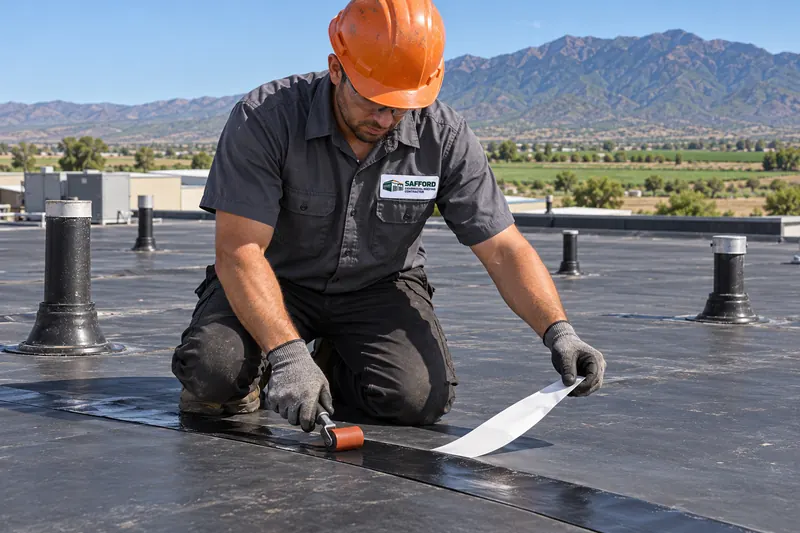
EPDM rubber flashes well into parapets and odd transitions, which suits adjoining buildings with steps and shared walls between roofs.
EPDM roofing details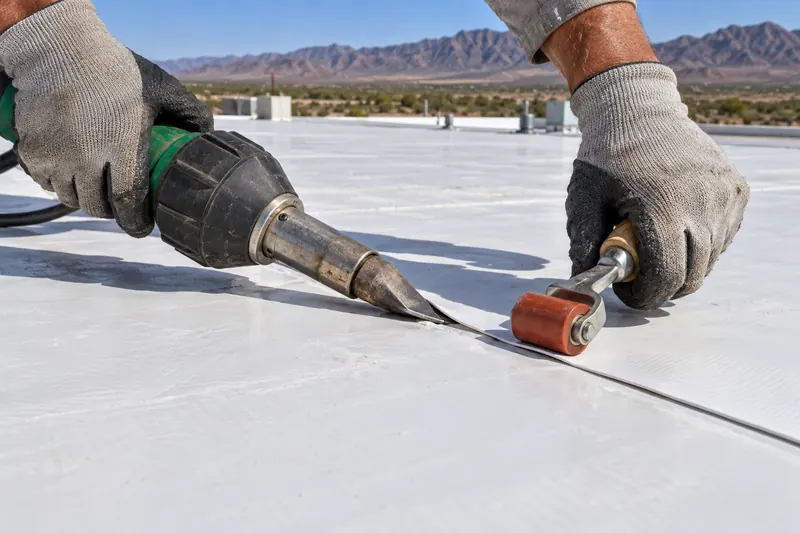
White TPO fits main-street roofs over cooled shops and offices, with welded seams that tie cleanly into new parapet flashing.
TPO roofing detailsShared Wall Leak?
Call and tell us which side the stain shows up on and what sits on both roofs. Tracing the leak to the right roof comes first.
Pima Process
The same five steps as any roof job, with the neighbor's roof and the shared wall planned into each one.
A walk of your roof and, with permission, a look over the wall at the neighbor's side. Water tests at the shared wall show which roof the leak comes from.
Shared-wall details touch two properties. A short note to the adjoining owner covers the work dates, access over the wall, and who pays for which side of the flashing.
Stacked patches, old roofing, and wet insulation come off down to the deck, and soft deck boards near the walls get replaced before new roofing goes on.
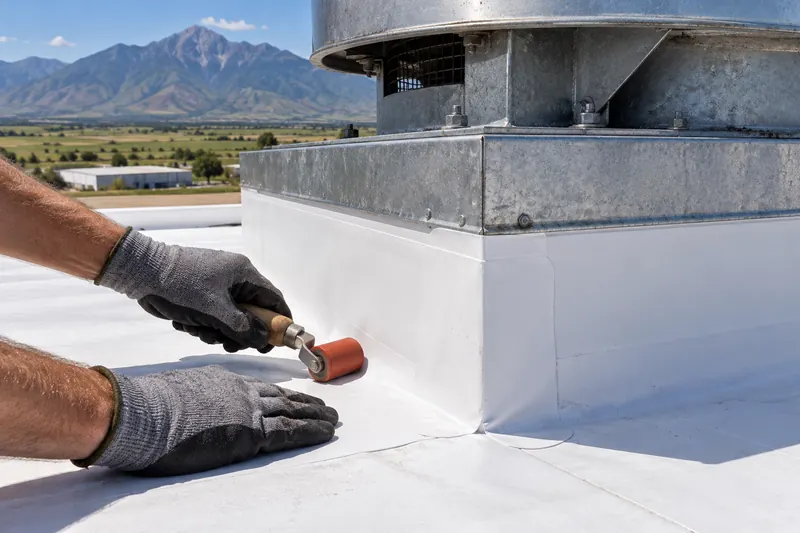
New EPDM or TPO goes down, runs up the parapet, and gets counterflashing that laps over the edge of both roofs so water sheds away from the shared wall.
Scuppers and gutters on your side get cleared, any blocked outlets on the shared line get noted for the neighbor, and you get photos of the finished details.
Nearby Towns
Commercial roofing east of Pima along US-70 and south toward the mountains.
Office, campus, and retail roofs under town design review.
Commercial roofs inside the City of Safford.
County parcels with metal shops along US-191.
Pima Questions
Answers for main-street and farm-trade building owners in Pima.
Two inspections a year, in spring and fall, plus a check after big storms. Clear drains, scuppers, and gutters of dust and debris, look for lifted seams, split flashing, and dried sealant, tighten backed-out metal fasteners, and check curbs and condensate lines. On adjoining buildings, check both sides of the shared wall too.
That comes down to where the water gets in, which a water test and a close look at the flashing usually show. Property records or a party-wall agreement settle who maintains the wall itself, and we document the roof side so both owners see the same evidence.
Yes, in most cases. New flashing runs up your side of the parapet and gets counterflashed, so your roof is sealed without working on theirs. Where the roofs meet without a parapet, the transition needs the agreement of the neighbor first.
Each patch adds a layer that cracks at a different rate in the heat, and water travels between layers before it drips. After several rounds of patches, the leak point and the drip point can sit many feet apart. Replacing the field ends the chase.
Only where it is soft or rotted. Bad boards get cut out and replaced before any roofing goes on, and the fastener pattern gets matched to the wood. Firm wood decks take new TPO and EPDM membranes without trouble.
Check with the Town of Pima Planning and Zoning office, which administers land use, zoning, and town codes and takes requests through an online portal. A full reroof or structural roof work on a commercial building usually needs a permit, and small repairs follow the rules of the town.
Coolers sit on curbs that leak when the curb flashing ages or the drain line drips onto the roof. New curb flashing, plus a drain line run to a drain or scupper, keeps that water off the new membrane.
Mostly, yes. Tear-off happens in sections, debris goes down a chute away from the entrance, and each section closes watertight by evening. Noisy work can move to early mornings before customers arrive on main street.
Free Estimate
Tell us about the building and whether it shares a wall with a neighbor. We will plan the inspection to cover both sides of that line.
Roof Question?
Leave a name and number and we will call you back about the building.
Or call now: +1 (623) 310-0167