Edge And Parapet
Wind from monsoon cells gets under loose coping caps and edge metal, then peels the membrane back from the corner. Look for lifted metal, open laps in the coping, and stains on the inside face of the parapet.
Gila Valley Commercial Roofs
As a Safford commercial roofing contractor, we install, replace, and repair TPO, EPDM, and metal roofs on shops, gins, clinics, and warehouses across the Gila Valley.
Roof Zones
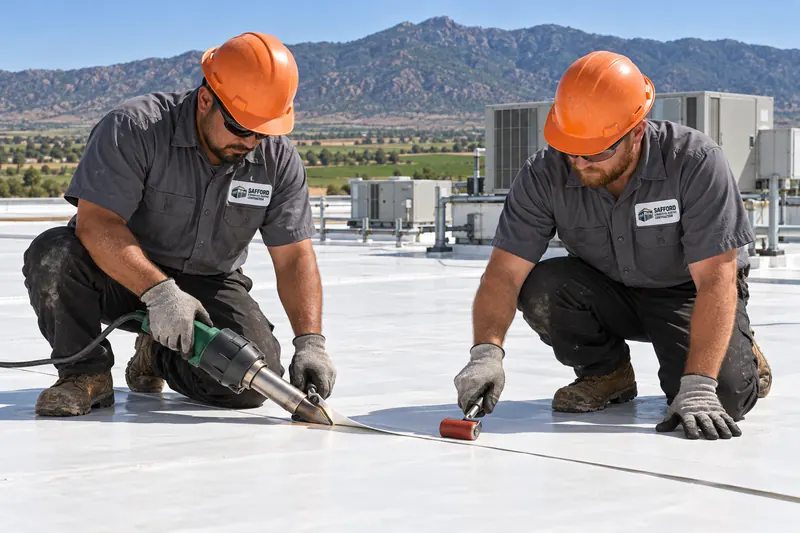
Most leaks on Gila Valley commercial buildings start in one of five places. Here is what to look for in each zone before you call about the roof.
Wind from monsoon cells gets under loose coping caps and edge metal, then peels the membrane back from the corner. Look for lifted metal, open laps in the coping, and stains on the inside face of the parapet.
Forty days a year at 100°F or hotter, then 74 nights at or below freezing, keep membrane seams moving. Open laps, curled patch edges, and a chalky, cracked surface show where the field is wearing.
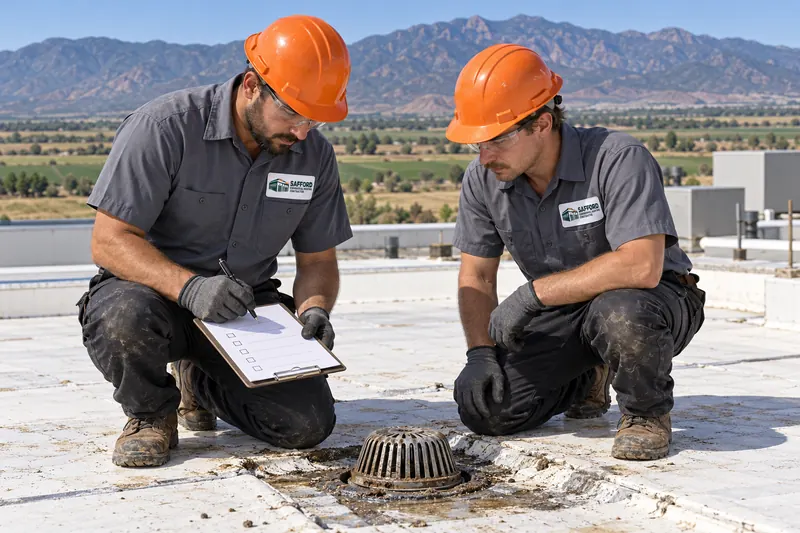
Dust, field debris, and bird nests collect in scuppers and drain bowls between storms. When the first monsoon downpour arrives, water backs up behind the parapet and finds every open seam nearby.
Rooftop units, exhaust fans, and pipe boots move and vibrate. Cracked curb flashing, missing storm collars, and worn paths around condensers are the usual sources of leaks above offices and clinics.
Soft spots underfoot, blisters, and ceiling stains far from any seam point to wet insulation. A core cut or moisture scan shows how much is wet before anyone prices a repair or a new roof.
Roof Systems
Each system fits a different kind of building. Match yours by roof slope, the space below the deck, and what runs on the roof.
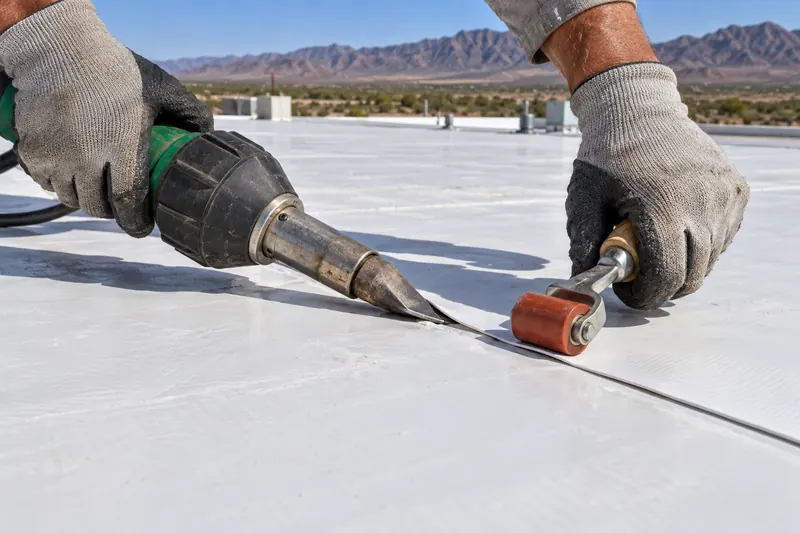
White, heat-welded membrane for low-slope roofs over air-conditioned retail, office, and clinic space, where a reflective surface helps the cooling load.
TPO roofing in Safford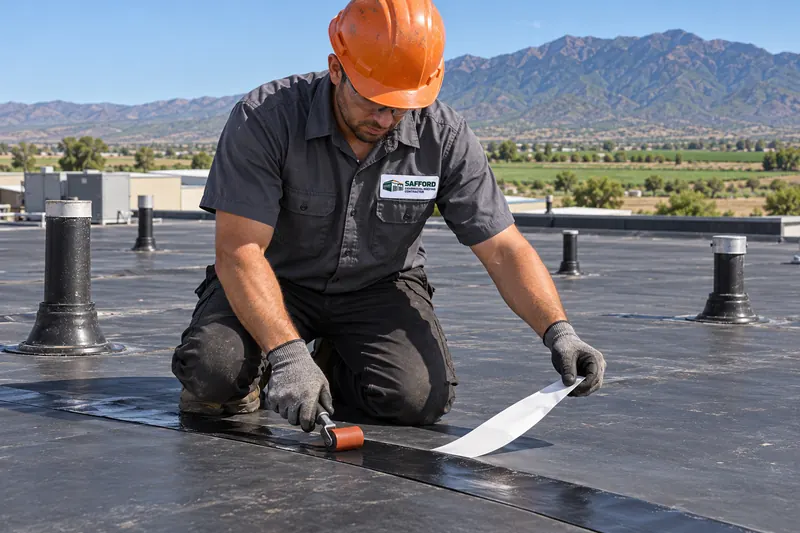
Rubber membrane for roofs with odd shapes, many pipe penetrations, or unconditioned space below, joined with taped seams that stay flexible on freezing nights.
EPDM rubber roofing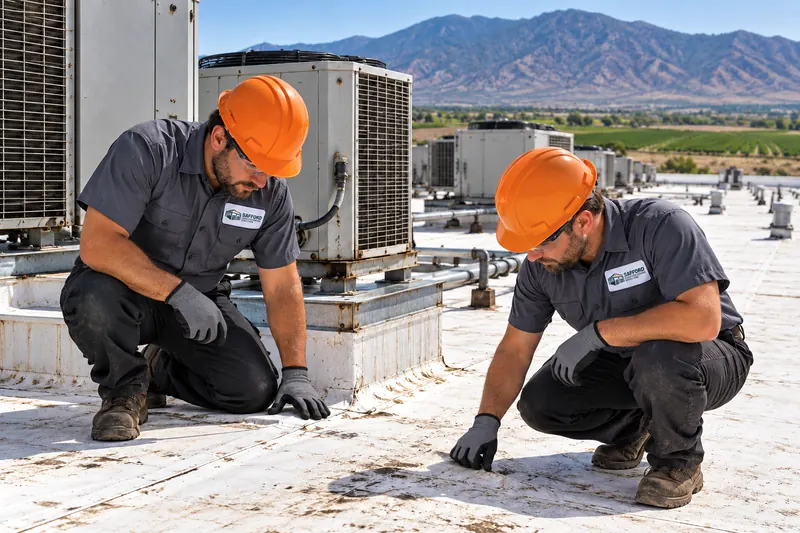
Large roofs on gins, processing plants, and mining-support buildings, planned around running equipment, dust load, heavy flashing at stacks, and fall protection.
Industrial roofs for plants and gins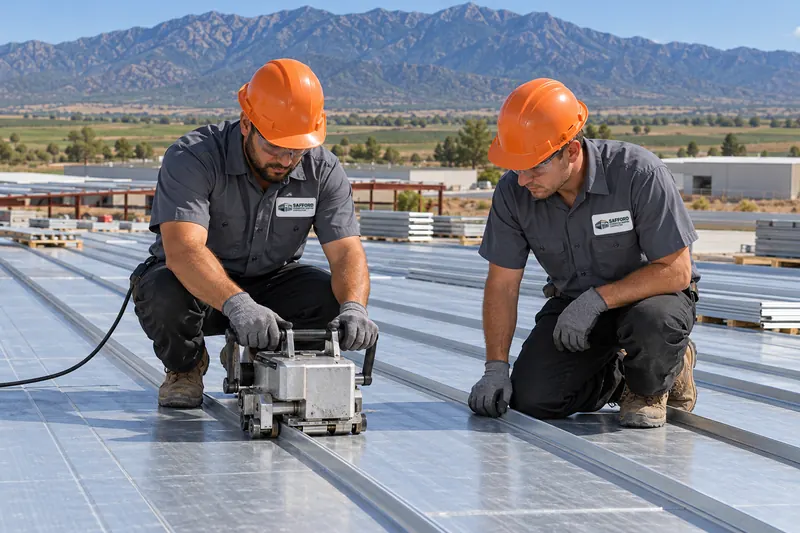
Standing seam and through-fastened panels for shops, barns, and pre-engineered steel buildings, plus metal retrofits that add slope over a tired flat roof.
Standing seam and metal roof systems| Building type | TPO Roofing | EPDM Roofing | Industrial Roofing | Commercial Metal Roofing |
|---|---|---|---|---|
| Retail strip, office, clinic | Reflective over cooled space | White EPDM option | Rarely | Rarely |
| Unconditioned shop or storage | Rarely | Durable, low upkeep | Rarely | Durable on sloped roofs |
| Cotton gin or processing plant | Reinforced membrane option | Rarely | Dust, vibration, large spans | Large clear spans |
| Pre-engineered steel building | Rarely | Rarely | Rarely | Matches the structure |
| Low-slope roof with many units | With walkway pads | Flashes many penetrations | Rarely | Rarely |
Before The Storms
Call before June 15, when the National Weather Service monsoon season opens. Mention the drains, scuppers, and any ceiling stains you already see.
Repair Or Replace
The answer comes down to how much of the insulation is wet and how much of the membrane or metal still holds up.
The Roof Year
Safford averages 40 days a year at 100°F or above and 74 nights at or below freezing (Arizona State Climate Office, 1991–2020 normals). Each season tests a different part of the roof.
June highs average 100°F. UV dries out old membrane, sealant, and patch edges until they chalk and crack, and a white TPO surface keeps the roof cooler over conditioned space.
Storms between June 15 and September 30 bring wind, blowing dust, and sometimes hail. Clear scuppers, fastened edge metal, and closed seams decide whether the rain stays outside.
Water left in cracks and ponded low spots freezes on cold nights at this elevation. EPDM stays flexible in the cold, and tightened metal fasteners close the leak path at panel laps.
Late spring is the time for a pre-monsoon roof check, and fall is the time to log what the storms did. Two visits a year keep small seam repairs small.
How A Job Runs
Every job starts on the roof with a look at the membrane or panels, the edges, the drains, and what sits underneath.
A walk of the whole roof, with photos of each problem area, probe checks on seams, and a look at every drain, scupper, curb, and edge. Core cuts or a moisture scan follow wherever stains or soft spots show up.
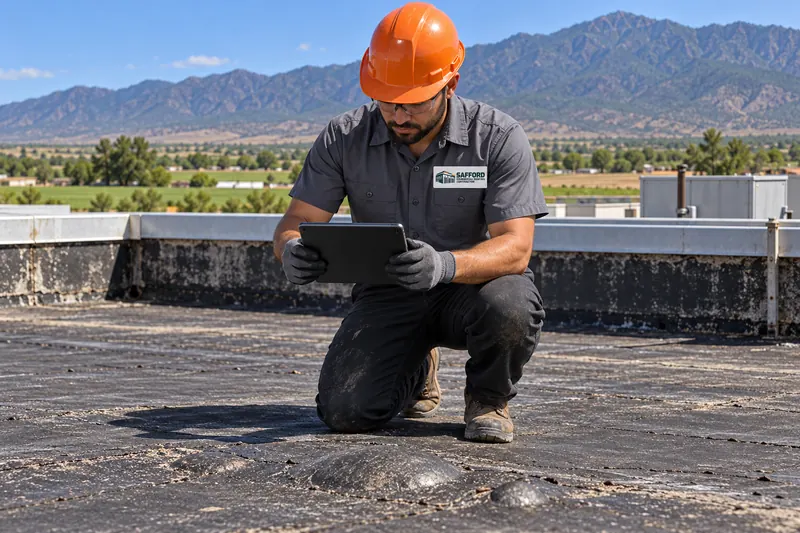
Findings go into a plain written scope: which seams, flashings, or panels get fixed, or why the roof needs a new system. Your estimate follows that scope line by line.
Work hours, crane and material staging, HVAC shutdowns, and loading-dock traffic get settled with your staff before anything comes off. Summer work days often start before sunrise to beat the afternoon heat.
Each section is opened, dried in, and closed before the crew leaves, so the building stays watertight overnight. TPO seams get welded and probed, EPDM seams taped and rolled, metal panels seamed or fastened.
Drains get flushed, debris leaves the roof, and every seam, curb, and edge gets a last check with your facility contact. You get photos of the work and a list of items to watch.
Service Area
Who issues the building permit comes down to whether the property is inside a city or town or in unincorporated Graham County. The map shows both.
| Place | From Safford | Permit office | What to know |
|---|---|---|---|
| Safford | Center | City of Safford | Retail on US-70 and US-191, county and school buildings, and warehouses serving copper mining work. |
| Thatcher | West, adjoining on US-70 | Town of Thatcher | Town design review applies to some visible changes in roof material or color. |
| Pima | West-northwest on US-70 | Town of Pima | An older farm-trade main street where buildings share walls and roof edges. |
| Solomon | East on US-70 | Graham County | Farm and processing buildings where roof work gets timed around seasonal runs. |
| Swift Trail Junction | South on US-191 | Graham County | County permits go through the Graham County online portal with plans and a plot plan sketch. |
Roof Questions
Short answers to what building owners ask first about their roofs.
Three ways at once. Summer UV dries out membrane, sealant, and coatings until they chalk and crack, daily swings between hot afternoons and cool nights pull at seams and fasteners, and monsoon storms bring wind, dust, downpours, and sometimes hail. Winter freezes split water trapped in cracks and ponded spots.
Any roof drawings, the age of the roof if you know it, and a list of where leaks show up inside. Photos of ceiling stains help, along with access details: a ladder, a roof hatch, or a locked door to the roof. The inspection still covers the whole roof either way.
Usually, by working backward from the stain. Water travels along the deck and insulation before it drips, so the search starts at the nearest curb, drain, seam, or wall flashing upslope of the stain. Core cuts then confirm where the insulation is wet.
Yes. Low-slope roofs get TPO or EPDM membrane, and sloped roofs on shops and steel buildings get standing seam or through-fastened metal panels. Some older flat roofs get a metal retrofit with framing that adds slope so water drains off.
Roof size, how much wet insulation comes off, and how many units and penetrations need flashing set the schedule. A small retail roof can be a few days of work, while a large plant roof gets phased over weeks. Monsoon storms add weather holds in summer.
On TPO and EPDM roofs with regular service traffic, yes. Pads mark the path from the hatch to each unit and protect the membrane from boots, dropped tools, and filter changes. A roof with many condensers and exhaust fans gains the most from them.
Free Estimate
Tell us the roof size and what you see inside the building. We will set up an inspection and talk through repair or replacement.
Roof Question?
Leave a name and number and we will call you back about the building.
Or call now: +1 (623) 310-0167